
Max Planck: Planck Constant, Planck Charge, Planck Mass, Planck Base Units, Slow adoption
- The Project Gutenberg eBook #40030: The Theory of Heat Radiation, 1914
- This Base Planck Units table is from Wikipedia (Table 2):
Planck | Base | Units | |
| Name | Dimension | Expression | Value (SI units) |
|---|---|---|---|
| Planck length | Length (L) |  | 1.616 229(38) × 10−35 m |
| Planck mass | Mass (M) |  | 2.176 470(51) × 10−8 kg |
| Planck time | Time (T) | 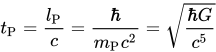 | 5.391 16(13) × 10−44 s |
| Planck charge | Electric charge (Q) | 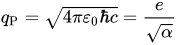 | 1.875 545 956(41) × 10−18 C |
| Planck temperature | Temperature (Θ) | 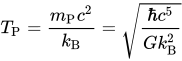 | 1.416 808(33) × 1032 K[12] |
- Equation generates the 10th line in the horizontally-scrolled chart.
- A notation by notation analysis (a working project)
- Engendered our ongoing analysis.

Academia was slow to adopt natural units and the Planck base units
- G. Johnstone Stoney, On the Physical Units of Nature, Scientific Proceedings, Royal Society of Dublin, 1881 (paper first read in 1874 at British Association, Belfast)
- Max Planck, The Theory of Heat Radiation (PDF), trans. Morton Masius, P. Blakiston’s Son & Co., 1912
- C. Alden Mead (UMinn) In 1959 he began his struggle to publish his work about the Planck Length. Though finally published in 1964, the article, Possible Connection Between Gravitation and Fundamental Length, Phys. Rev. 135, B849 (10 August 1964), was ignored by the scholarly community. Planck Length commanded no respect as a fundamental unit of length.
- John Barrow (1982): With an extraordinary depth and range of scholarship, and a sensitivity to young students, my first letter to John Barrow in 2013 was an earnest request for help, “What do we do with these numbers?” He never commented about my naive attempt to shoehorn everything-everywhere-for all time into 202 base-2 notations. Barrow died on September 26, 2020. See: Natural Units Before Planck, Quarterly Journal of the Royal Astronomical Society, Vol. 24, P. 24, 1983
- Thanu Padmanabhan: His 1985 article — Physical significance of planck length (PDF) — captured my attention. His nonperturbative approach produced a quantum cosmological model free from singularities and the horizon problem. I was very surprised and gratified to see that his article was published so early in his career. He was just 28 years old (born March 10, 1957). Yet, with guidance from India’s renown astrophysicist, Jayant Vishnu Narlikar, he became a most prodigious scholar.
- John Archibald Wheeler, Physics at the Planck Length, International Journal of Modern Physics A, Vol. 08, No. 23, pp. 4013-4018 (1993).
- Joseph Polchinski. Quantum gravity at the planck scale, 1998 Polchinski
- Frank Wilczek (2001) became a Nobel Laureate in 2004, yet he continued his wide-eye, open, and enthusiastic approach to the unknowns within life. He was one of the first of those within his caliber who encouraged our explorations. His three articles about Planck units truly opened the door for the rest of us.
- Other considerations: Hypothesized is that the Planck base units, defined by dimensionless constants, do not go smaller, but define the bridge between the finite and infinite.
- Long before George Johnstone Stoney and Max Planck worked to discern natural units, scholars have tried to discern the most basic units that define reality throughout all time. In the 1800s that effort became an international collaboration and by 1992, it became a global standard, ISO-31, defined by the International Organization for Standardization (ISO). Within that framework, in 2016, Peter J. Mohr, David B. Newell, and Barry N. Taylor published “CODATA Recommended Values of the Fundamental Physical Constants” in the Journal of Physical and Chemical Reference Data.
- Discussions about the necessary dimensionless constants needed to construct the universe are helpful. In 2005, the work of Frank Wilczek, Anthony Aguirre, Martin Rees, and Max Tegmark emerged; they thought 31 physical constants would be required to start the universe. A bit later in 2011 John Baez wrote How Many Fundamental Constants Are There? and assumed 26. The simple question is then asked, “From where do those 26 or 31 originate?” Hypothesis: “Deep within pi on a bridge between the finite and the infinite.”
- In July 2023, before AI was applied to the search engines, there were 2632 articles just within ArXiv that explored “Planck scale physics.” On September 15, 2023 there were 35,700 (same search: “Planck scale physics” + “ArXiv”).
- Even our most distinguished physicists, people like Cumrun Vafa of Harvard, have problems with the Planck scale. This homepage opens with it (July 2023).
###