
Everything, Everywhere, For All Time,
Is Numbers, Geometry, and Equations.
Key Is An Infinitesimal Sphere Defined By Planck’s Natural Units.
by Bruce E. Camber
Abstract. In spite of the fact that Stephen Hawking talked about the universe expanding exponentially, at no time did scholars look at key baseline numbers and analyze a simple base-2 exponential expansion of the universe. Our first base-2 exponential expansion of the universe first started as a three-dimensional, Zeno-like walk, back down inside nested tetrahedrons-and-octahedrons. That walk started in a classroom and went down in size 112 steps to the Planck Length and Planck Time, then turned around and used the Planck units for measurement, and in 202 notations mapped the universe. The year was 2011.
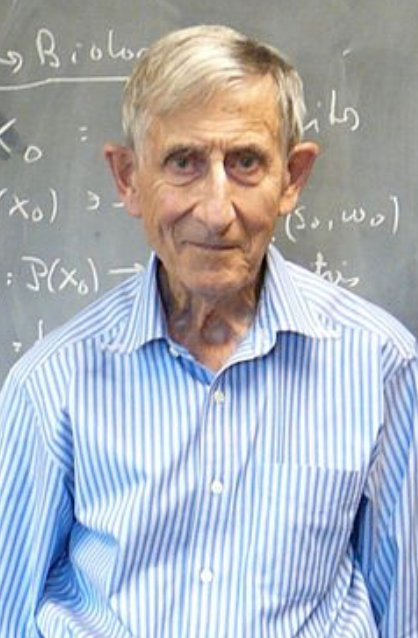
Introduction. The extended story of that day in 2011 is here: https://81018.com/home/ The first reported realization that it was a direct challenge to big bang cosmology was in the first letter to Stephen Hawking on August 3, 2014. Although acknowledged by Jonathan Wood, there was no further discussion. Two years later, a letter to the master of inflation, Alan Guth, was informed, friendly, but ignored. In those early years we were privileged to get the advice of Freeman Dyson of the Institute for Advanced Studies (IAS) and from Frank Wilczek of MIT. They both encouraged our explorations, they thought base-2 was a novel concept, but did not encouraged it. It took laying the notations out in a 202-horizontally-scrolled columns so we could check the numbers more directly. A foremost biology professor (and the one who intuited the existence of the Archea), from University of Houston, George Fox, inspired our analysis of notation 31, 67, 101, 137, 167, and 199. A Brown University professor, Philip Davis, suggested that we focus on the sphere as a basic building block. A mathematician from China’s Hunan province had a parallel construct. Nobody had quite put it all together.
Research: Base-2 notation from the Planck Units. In January 2020, Marcel Danesi emerged with a chapter of his book, Pythagoras’ Legacy: Mathematics in Ten Great Ideas. The chapter, “Exponents: Notation and discovery,” gave us perspective. It seemed as if there was no scholar on the high ground who had clearly seen. the universe in terms of exponential notation. This article naturally followed: Titled, “Nobody had done a simple base-2 calculation from Planck’s base units…”
Multiplying and dividing by 2 is something we begin to learn in the first and second grades. By the sixth grade we believe we know it. Yet, 264 and 2202 were never part of any textbook. Plato’s base units had been minimized in the geometry textbooks. The places of spheres and pi(π) were also modestly introduced.
If Planck Time were the first moment of time, and with Planck Length, a calculation can be made. That is, there are 18.5 tredecillion spheres per second being generated. That changes the dynamics of the infinitesimal. That changes the look and feel of exponential notation.
Reality. The discussion continued at the baseline — https://81018.com/ether/ — and continues with a review of our errors — https://81018.com/mistaken/ — that keeps base-2 notation out of the limelight.
Our task is to shine the lights on the many facets of this construction.
___
Boundaries and Boundary Conditions:
Planck Units as Natural Boundaries: The Planck units are defined by fundamental constants of nature, speed of light, c; gravitational constant, G; reduced Planck constant, ħ; and Boltzmann constant,k_B; and are seen as natural scales where quantum effects of gravity become significant. These units provide a conceptual boundary where current physical theories like general relativity and quantum mechanics might merge or require new physics to explain phenomena at this scale. The Planck scale could thus serve as a theoretical limit or boundary condition for physical theories, suggesting that below these scales, our understanding needs reevaluation or new frameworks.
- Base-2 Notation: Applying base-2 (binary) notation to these scales involves a geometric progression where each step doubles from the last. This method could be used to model the universe’s expansion or the structure of matter from the smallest scales (Planck length) to the observable universe. By using this notation, one might explore how physical quantities scale and potentially identify critical points or transitions in physical phenomena. This could offer insights into the symmetry and patterns in nature at different scales.
- Parameter Set for Further Research: Scaling and Universality: The base-2 notation from Planck units might help in understanding the scaling laws of physical phenomena. Since Planck units are natural units, using binary scaling could provide a universal parameter set that applies across different scales of the universe, from quantum to cosmological. This approach might reveal patterns or constants that are invariant across different scales, potentially aiding in the development of unified theories or in the study of fractal-like properties of the universe.
- Theoretical Physics and Cosmology: In theoretical physics, particularly in areas like quantum gravity or cosmology, this method could be used to hypothesize about the early universe, where the Planck epoch might be the starting point for the Big Bang. Here, base-2 scaling from Planck units could help in setting initial conditions or parameters for models of cosmic inflation or the evolution of the universe, providing a structured way to explore these vast scales of space and time.
- Limitations and speculative nature: While conceptually appealing, this approach is highly theoretical. The Planck scale is where our current understanding of physics breaks down, and thus, any model or parameter set derived from it, especially using an abstract scaling like base-2, would be speculative. It requires not only new theoretical physics but also potentially new experimental methods or observations to validate or refine such models.
In summary, while base-2 notation from Planck base units does offer a fascinating framework for conceptualizing boundaries and parameters in physics, its practical utility for setting definitive boundary conditions or providing a concrete parameter set for research is still speculative. It serves more as a thought experiment or a tool for theoretical exploration, suggesting directions for where physics might need to evolve to encompass all scales of nature.