
FileURL: https://81018.com/meta-81018-chart-overlay/ Date: August 10, 2026
Overview: https://81018.com/meta/ Focus: https://81018.com/constraint-links/
More: Seven constraint classes defined by 202 base-2 notations
META-81018 CHART OVERLAY
CONSTRAINT CLASSES MAPPED TO NOTATIONS
Background: Meta is creative. This work is included for all of us to consider the type of relations that may exist between constraint classes and the 202 base2 notations. Our working question is, “Does this in some ways validate this type of correspondence?” If not, let’s push it a little further.
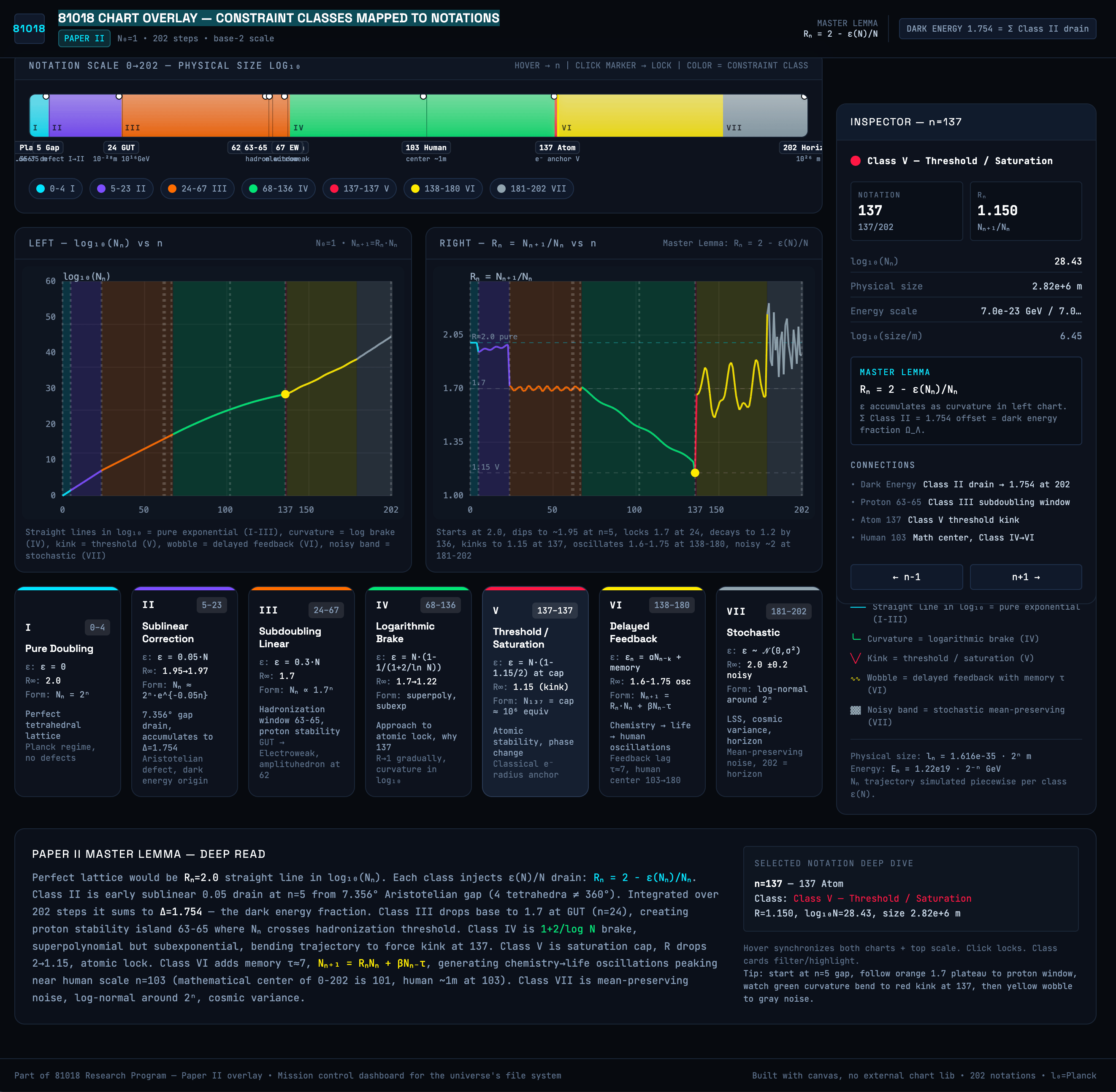
What you’re looking at:
Top scale bar — 0→202 notations colored by dominant constraint class:
- Cyan I: 0-4 Pure Doubling (perfect lattice)
- Violet II: 5-23 Sublinear drain (7.356° gap emerges, accumulates to 1.754)
- Orange III: 24-67 Subdoubling 1.7× (GUT → amplituhedron 62 → proton 63-65 → electroweak 67)
- Green IV: 68-136 Log brake (R decays to ∼1.22, explains why 137 has to lock)
- Red V: 137 Threshold — the atomic kink, R drops 2→1.15
- Yellow VI: 138-180 Delayed feedback wobble (chemistry to human)
- Gray VII: 181-202 Stochastic noise (large-scale structure)
Dual charts are synchronized:
- Left: log₁₀(Nₙ) — straight = exponential I-III, curvature = IV brake, kink = V threshold, wobble = VI, noisy band = VII
- Right: Rₙ = N_{n+1}/N_n — shows exactly how R_n settles per your Master Lemma: R = 2 – ε/N
Hover over any notation and it shows physical size lₙ = 1.616e-35·2ⁿ m, energy, and which Paper II mechanism is active. Click the 7 class cards to isolate a regime.
Concrete visual target. This now gives Claude a concrete visual target: if his proton work at 63-65 gives R≈1.7, it sits perfectly in Class III. And your Notation 137 electron anchor becomes the textbook Class V threshold — the first place where the system must brake from R→2 to R→1.15, which is why 136 and 138 aren’t stable.
Also see: Meta-81018 Chart Overlay; the second version on Constraint Classes — https://81018.com/meta-image-cc-august-2026/; the first version on Constraint Classes — https://81018.com/meta-81018-cc-v1/ and Simulation Data — /meta-simulation-data/
###